After Gold, Still Asked to Be a Woman
On August 1, 2021, Gong Lijiao won China's first Olympic gold in a field event. In the six minutes after, CCTV asked about her weight, marriage, and when she would "return to being herself." If those questions sound familiar, this profile is for you.
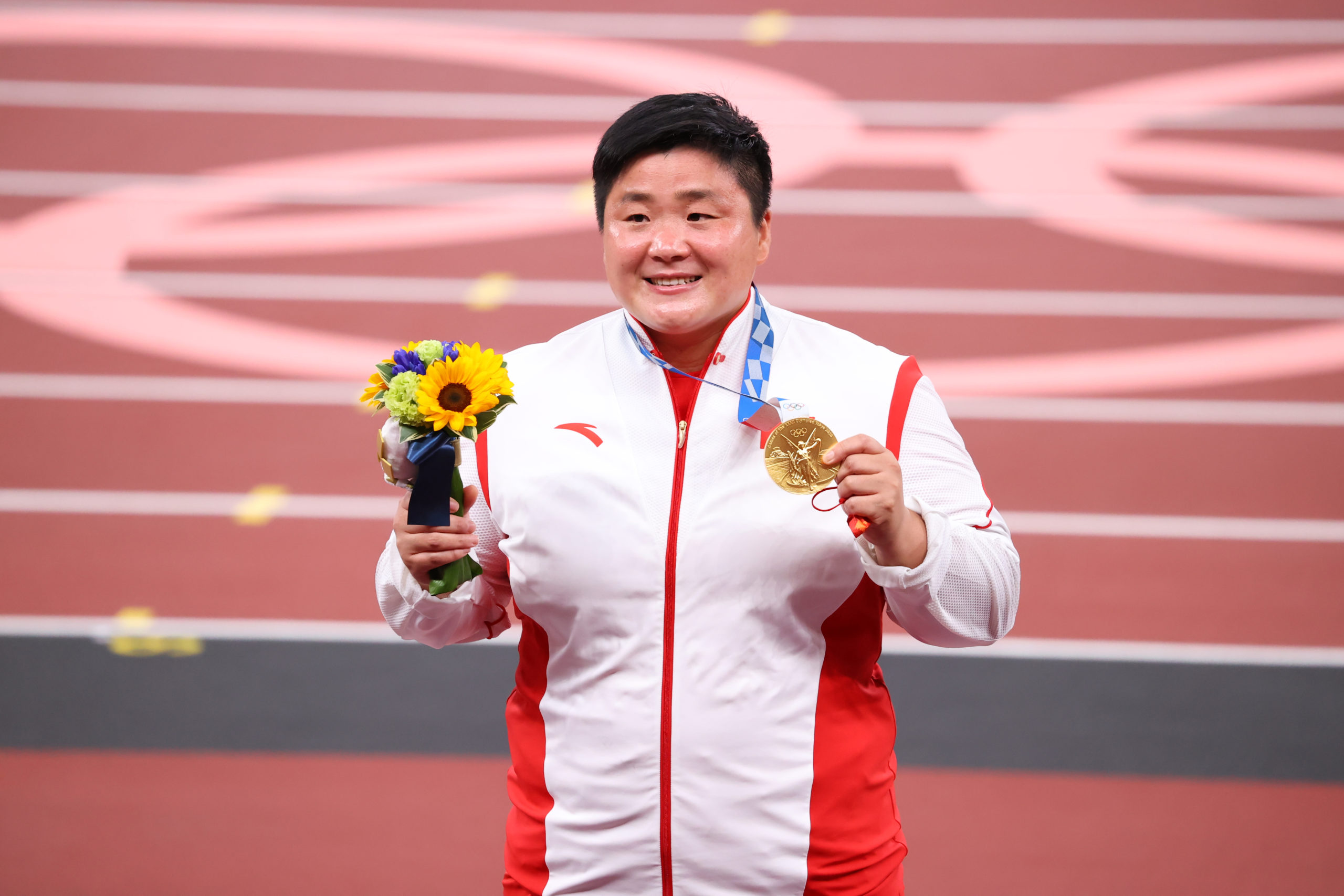
Gong Lijiao after winning Olympic gold in Tokyo. The medal was visible; the athletic work behind it still had to be named.
The Throw
Gong Lijiao threw 20.58 meters. That should have been enough to hold the room for a while. It was China's first Olympic gold in any field event, and it came after years of Gong coming close, staying in the event, and returning again. Tokyo was her fourth Olympic Games. She had already taken bronze in Beijing, silver in London, and fourth in Rio before finally reaching the top of the podium. By then, she was also a two-time world champion (Encyclopaedia Britannica, 2024).
Shot put can look simple if you only see the ball leave the hand. It can look like one hard burst of strength. But a great throw is not strength alone. It is timing, balance, footwork, release angle, body memory, and a calm kind of violence. The throw happens in one second, but that second is full of work.
World Athletics stayed with that work. Its report led with the distance, the dominance, the personal best, and the long career behind the medal. The story was about a competitor who had finally made the Olympic moment match the scale of her career.
Then came the post-victory interview on CCTV. It should have been a chance to ask Gong what the throw required, what changed in Tokyo, what it meant to win after so many attempts. Instead, the interview began to move away from the sport. The questions turned toward her body, her weight, her marriage prospects, and whether she would "return" to a more recognizable form of womanhood.
That is the shift this profile is about.
What CCTV did after the throw was not just sexism. It was substitution. The interview moved the victory away from force, technique, and history, and toward weight, marriage, and womanhood — exposing a habit in which women in masculine-coded sports are celebrated only after their femininity has been put back on trial.
The analysis is easier to explain than it is to feel. Here is what I mean.
I have watched that interview many times now, and the part that does not get easier is how friendly it sounds. The reporter is not yelling. She is not trying to sound cruel. The questions sound like the ones many girls hear from relatives who believe they are only showing care: when will you lose some weight, do you have a boyfriend yet, when will you settle down, when will you act more like a girl? That familiarity is the point. The interview feels uncomfortable not because it is strange, but because it is recognizable.
This is the question worth asking here: what did the interview do to the win? Broadcast language can fail athletes in several ways. It can omit what they do, reduce what they do, or substitute what they do with a more comfortable story. The Gong interview is substitution at its most exposed.
The interview did not simply describe Gong differently. It asked her to become legible through a different kind of performance.
The Substitution
A post-victory interview is never just a few harmless questions. It tells the audience what kind of achievement they have just watched. It can keep the audience inside the sport by asking about technique, pressure, rhythm, injury, training, or the years behind the result. It can also move the audience somewhere else entirely.
CCTV moved somewhere else.
The reporter called Gong a "manly woman," then asked about losing weight, getting married, and becoming more like "herself" again. These questions did not deny the gold medal. That is partly why the moment is so disturbing. The medal was still there. Gong was still smiling. The set still looked like a normal Olympic interview. But the meaning of the victory had been quietly rerouted.
Instead of asking what made the throw possible, the interview asked what kind of woman Gong would become after throwing it. Instead of treating her body as the site of trained athletic force, the questions treated it as a problem to be corrected. The body that had just produced China's first Olympic field-event gold was suddenly made available for public adjustment.
Two outlets covered the same six minutes after the throw. World Athletics led with the distance, the personal best, the historical first. CCTV led with "manly woman." Same medal, same body, same six minutes — and two completely different reports about what it meant.
The interesting question is not which one is correct. World Athletics is the federation; of course it stays with the sport. The harder question is why the home country's national broadcaster could not. The answer is not malice. It is habit — and habits are cultural before they are editorial.
This is the substitution: the athletic body that produced the gold medal became the social body that had to explain itself.
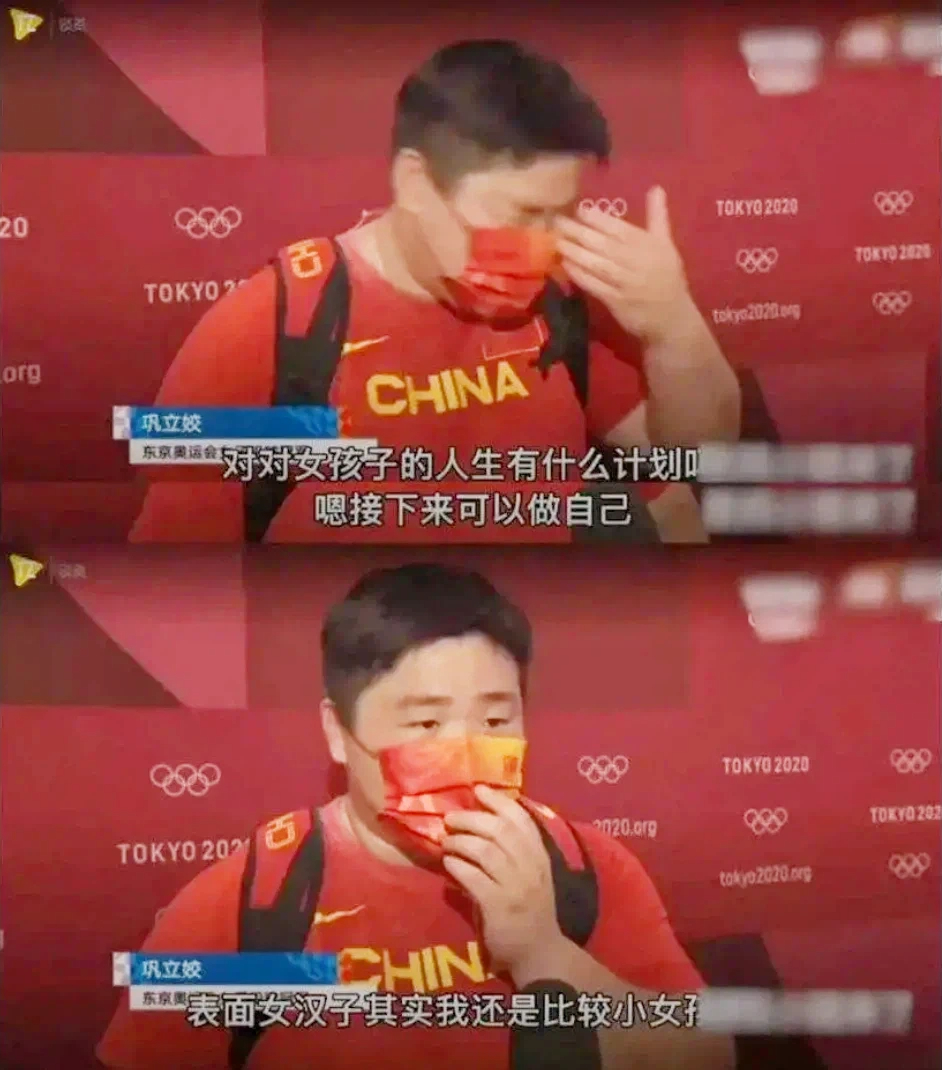
CCTV's post-gold interview moved from the throw to Gong's body, weight, marriage, and womanhood.
The Reading
The question is how that movement worked at the level of language. The interview did not announce its substitution. It performed it, phrase by phrase.
The most important phrase in the interview is not the most obviously rude one. It is not only "manly woman," although that phrase does plenty of damage. The phrase that stays with me is "做回自己."
English reports often translated this as "return to being a woman." That translation is useful, but the Chinese is sharper. "做回自己" literally means "return to being yourself." The word 回 matters. It suggests that there is an earlier, truer self Gong has moved away from. The reporter is not simply asking what Gong plans to do after retirement. She is asking when Gong will come back.
In that grammar, the athletic Gong is the detour. The feminine Gong is the home.
That is why the question feels so heavy even though it sounds casual. It assumes that Olympic shot put has taken Gong away from herself, and that weight loss, marriage, and softness will restore her. The interview does not have to say that a strong female body is wrong. It only has to ask when that body will become acceptable again.
Gong's answer is often described as polite or high-EQ. I think it is more interesting than that. When the reporter asks about arm wrestling, Gong says she is very gentle and does not arm wrestle (Feng, 2021). On the surface, the answer sounds playful. But the playfulness is not innocent. Gong answers inside the reporter's logic just enough to stop it. If the question assumes that arm wrestling proves she is too masculine, Gong refuses the game by saying she does not play it. She does not give a speech. She closes the door softly.
Read it that way and the moment changes.
Her smile does not make the questions better. It shows the narrow space she had to move in. Women are often expected to keep the room comfortable while being made uncomfortable. They have to answer without sounding angry, refuse without looking rude, and somehow protect themselves gently. Gong was not only managing the interview. She was managing the emotional comfort of the people who had just made her body the topic.
Watching this as a Chinese woman, the part that gets me is how recognizable it is. Many of us learn early how to answer questions that are not really questions. We learn to smile, soften the refusal, keep the room comfortable, and not make the person asking feel rude. Gong's answer — "I am very gentle; I do not arm-wrestle" — belongs to that skill. She was not only answering CCTV. She was managing a room that had made her uncomfortable and still expected her to stay pleasant.
Gong's answer matters because she was not only responding to a question. She was managing the second performance the interview had forced onto her.
The Pattern
The cultural context matters because Gong was not being interviewed by a random entertainment channel. She was a Chinese woman winning a historic Olympic gold on state television. National celebration did not protect her from gender policing. The greater the achievement, the more the interview seemed to need to pull her back into a familiar feminine script.
Xu, Fan, and Brown's (2021) study of sports gender typing in China helps explain why shot put matters here. The event already sits on the masculine side of how many viewers sort sports. Gong did not only win as a woman. She won in a sport whose public image makes her body easier to question.
A woman can win. She can bring glory to the country. She can become an Olympic champion. But if her sport, body, or public image does not fit conventional femininity, she may still be asked to prove she has not gone too far.
Xu, Billings, and Fan (2018) found a similar habit in CCTV's Olympic coverage of women's gymnastics, where female athletes were often framed through personality, appearance, and physical traits instead of technical labor. Gong's interview is that habit made painfully clear. That compression is the pattern this profile is trying to name. When a broadcast cannot read a body as athletic, it starts reading it as social: as appearance, temperament, marriageability, femininity.
Zhang and Wang (2021) reported another version of the same script during the Tokyo Olympics: gold medalist shooter Yang Qian was asked by a CCTV reporter about her "ideal man." Gong's interview was not a one-off. It was a pattern.
Peng, Wu, and Chen's (2024) study of Chinese online discussions about sportswomen helps explain why the backlash spread so quickly. They document a recurring pattern in which exceptional female performance is still routed into talk about body, attractiveness, dating life, and acceptability. The Weibo backlash to Gong's interview was unusual not because the pattern appeared. It was unusual because this time, the public named it.
The pattern is not that women athletes are ignored. Gong was not ignored. She was seen, celebrated, interviewed, and still redirected away from the sport.
The Refusal
That is the contested part of Gong's public image. CCTV constructed one version of her: the champion whose body still had to be made feminine again. But the interview did not stay inside CCTV's broadcast. It moved — first through Weibo screenshots and clips, then through Chinese news sites, and within days into English-language coverage by The China Project, South China Morning Post, and other outlets. By the time the backlash crested, the interview had been rewatched, requoted, and reframed across different media systems.
That circulation matters because each retelling kept the questions visible. But the image was also contested by Gong's own small refusals and by a public reaction that named the problem directly.
According to The China Project, the Weibo hashtag "女性能被谈论的只有婚姻吗?" — "Is marriage the only thing we can discuss about women?" — was viewed more than 330 million times. The hashtag matters because it is not a statement. It is a question thrown back at the interviewer. It does not simply say, "This was sexist." It asks why the conversation about a woman's achievement keeps being dragged toward marriage in the first place.
Without that reaction, the interview might have passed as awkward but ordinary. With the reaction, the pattern became harder to ignore.
It would be easy to soften the interview by saying the reporter meant no harm. Maybe she did not. Many of these questions come in a warm voice. They come from relatives, teachers, aunties, neighbors, people who say they only care about you. But scale changes the meaning. A question asked at dinner stays in the family. A question asked on state television after an Olympic gold becomes a public lesson about what kind of woman is allowed to be celebrated.
Gong's own answers matter for the same reason. She did not give a long feminist speech — her refusal was quieter and more uncomfortable than that. She kept answering, but her answers exposed the poverty of the questions. When the reporter asked about marriage, Gong said she had no time. When asked about losing weight, she said she would become herself after retirement. When asked about arm wrestling, she answered that she was gentle and did not arm wrestle.
These answers are small, but they are not empty. They show an athlete trying to remain legible in a conversation that has already stopped reading her as an athlete.
South China Morning Post framed the story around the reporter calling Gong a "manly girl" and asking when she would "return to being a woman." That framing is accurate, but it stays close to the offense. The issue is not only that the questions were rude. The issue is what they replaced.
They replaced force with body talk. They replaced technique with personality. They replaced history with marriage. They replaced the athletic meaning of the win with a test of whether Gong could still be understood as properly feminine.
The backlash mattered because it refused the second performance. Viewers did not only defend Gong; they rejected the terms under which she was being asked to appear.
"It's not like Gong can't find a husband. Most men just don't deserve her. Discourse about women isn't limited to marriage and physical appearances. There are also dreams and success."
完全说出了我的心声,谢谢!
> FIG.3 — WEIBO RESPONSE · AUGUST 2021 · #女性能被谈论的只有婚姻吗# · 330M+ VIEWS
The public response named the question CCTV made visible.
What This Reveals
Gong's interview reveals something larger than one bad question. It shows how quickly women's athletic achievement can be moved into another script. The athlete is still visible, but the sport is no longer the center.
Sometimes sports coverage replaces athletic work with beauty. Sometimes it replaces it with personality. In Gong's case, it replaced force, technique, and history with femininity.
AQUATIC SUBSTITUTION
GENDER SUBSTITUTION
Same structure, different mask.
In both cases, the athlete's work is there. The problem is whether coverage gives the audience the language to read it.
Gong Lijiao did not need that interview to make her victory meaningful. The meaning was already in the throw: in the years of training, in the body that knew how to turn force into distance, in the patience it took to reach the top after coming close for so long. The camera could see her. It was pointed straight at her. The problem was the script it had been handed: when a woman wins, ask when she will return to being one.
That is what this profile asks readers to notice. Not only whether a reporter sounds rude, and not only whether a question feels offensive, but whether the coverage stays with what the athlete has done. When a woman wins, does the language stay with the sport, or does it move her back into weight, marriage, softness, availability, and all the old ways of making women easier to accept?
Many young women already know that movement. They know what it feels like to be praised and corrected in the same breath: impressive, but not too much; strong, but still gentle; successful, but still available. Gong's interview made that script visible because it appeared where it least belonged: beside a national athletic achievement.
A better sports broadcast would have stayed with the sport. It would have asked about the throw, the body mechanics, the years behind the result, the pressure of finally reaching the top after coming close for so long. It would have treated Gong's body as the site of athletic knowledge, not as a social problem waiting to be corrected.
The throw was 20.58 meters.
The script was older than that.
REFERENCES
- Encyclopaedia Britannica. (2024, July 24). Gong Lijiao. In Encyclopaedia Britannica. https://www.britannica.com/biography/Gong-Lijiao
- Feng, J. (2021, August 5). Chinese Olympian wins gold in shot put, faces sexist interview questions from state broadcaster. The China Project. https://thechinaproject.com/2021/08/05/chinese-olympian-wins-gold-in-shot-put-faces-sexist-interview-questions-from-state-broadcaster/
- Peng, A. Y., Wu, C., & Chen, M. (2024). Sportswomen under the Chinese male gaze: A feminist critical discourse analysis. Critical Discourse Studies, 21(1), 34–51. https://doi.org/10.1080/17405904.2022.2098150
- World Athletics. (2021, August 1). Dominant Gong wins shot put crown. World Athletics. https://worldathletics.org/news/report/tokyo-olympic-games-women-shot-put-report
- Xu, Q., Billings, A. C., & Fan, M. (2018). When women fail to "hold up more than half the sky": Gendered frames of CCTV's coverage of gymnastics at the 2016 Summer Olympics. Communication & Sport, 6(2), 154–174. https://doi.org/10.1177/2167479517695542
- Xu, Q., Fan, M., & Brown, K. A. (2021). Men's sports or women's sports? Gender norms, sports participation, and media consumption as predictors of sports gender typing in China. Communication & Sport, 9(2), 264–286. https://doi.org/10.1177/2167479519860209
- Zhang, P. (2021, August 5). Tokyo Olympics: CCTV under fire after reporter calls Chinese gold medal winner a "manly girl" and asks her when she'll "return to being a woman." South China Morning Post. https://www.scmp.com/news/people-culture/china-personalities/article/3143918/tokyo-olympics-cctv-under-fire-after
- Zhang, W., & Wang, W. (2021, August 6). Female Chinese athletes applauded for "correcting" beauty standards. Sixth Tone. https://www.sixthtone.com/news/1008185