A broadcaster for authored sport · China Mermaid Open · Season 2026
↓ Scroll to Enter
CHINA MERMAID OPEN
02RHETORICAL POSITION
THE SPORTALREADY HASA SCORING SYSTEMBUILT ONAUTHORSHIP.
ITS BROADCASTCOVERAGE DOESNOT YET KNOWHOW TO SAY SO.
The China Mermaid Open scores every performance across four dimensions — movement completion, technical difficulty, performance expression, and creative choreography — with nearly fifty individually valued elements. Since 2025, a dedicated art panel evaluates choreography, artistic expression, and cultural integration separately.
The rules already treat athletes as authors.
Current broadcast coverage doesn't use that language.
It teaches audiences to feel before it gives them anything to read. Work titles become mood cues. Scores become verdicts. The athlete's compositional choices disappear into atmosphere.
Pressure Line broadcasts what the scoring system already describes.
0
+
Scored Elements
per performance
0
+
Athletes
10 countries & regions
0
Scoring Dimensions
movement · difficulty · expression · choreography
0
+
Legs / Season
national circuit
Broadcast the Labor Beneath the BeautyChina Mermaid Open · Season 2026
WORK TITLE: UNNAMED
SCORE GAP: UNEXPLAINED
CULTURAL SOURCE: UNNAMED
ATHLETE AS IMAGE — NOT AUTHOR
DIFFICULTY TIER: NEVER CITED
CHOREOGRAPHIC INTENT: IGNORED
SCORING MECHANISM: ABSENT
MOVEMENT NAME: NOT GIVEN
WORK TITLE: UNNAMED
SCORE GAP: UNEXPLAINED
CULTURAL SOURCE: UNNAMED
ATHLETE AS IMAGE — NOT AUTHOR
DIFFICULTY TIER: NEVER CITED
CHOREOGRAPHIC INTENT: IGNORED
SCORING MECHANISM: ABSENT
MOVEMENT NAME: NOT GIVEN
50+ SCORED ELEMENTS·4 SCORING DIMENSIONS·0 WORK TITLES NAMED ON BROADCAST·70+ ATHLETES·40-PT GAP — MECHANISM UNEXPLAINED·10 REGIONS REPRESENTED·"MERMAID IMAGE" — NOT COMPETITOR AT WORK·NATIONAL INTANGIBLE HERITAGE IN COMPETITION·CULTURAL AUTHORSHIP: UNNAMED BY COVERAGE·50+ SCORED ELEMENTS·4 SCORING DIMENSIONS·0 WORK TITLES NAMED ON BROADCAST·70+ ATHLETES·40-PT GAP — MECHANISM UNEXPLAINED·10 REGIONS REPRESENTED·"MERMAID IMAGE" — NOT COMPETITOR AT WORK·NATIONAL INTANGIBLE HERITAGE IN COMPETITION·CULTURAL AUTHORSHIP: UNNAMED BY COVERAGE·
THE GUIDEBOOKRead what the scoring system already says.↓
PL
A Broadcaster's Guidebook
CHINA MERMAID OPEN
Season 2026 Edition For Producers · Camera Operators · On-Air Talent
↓ Scroll to Read
PL
PRESSURE LINE
BROADCASTER'S GUIDEBOOK
China Mermaid Open · 2026
Contents
Introduction
I. How Spectacle Language Works
II. Our Position on the Sport
III. Broadcast Standards
Conclusion
00
Introduction
Introduction
Pressure Line covers sport the way it actually is — not the way it photographs.
We start with what the performance is trying to do — not what it looks like. Commentary names the work and explains the construction. Camera follows the athlete's structure. Editing serves the choreography. Everything else is secondary.
FIG. 1 — Official scoring criteria, 2024 Shanghai Haichang leg. Click to read full report ↗
The China Mermaid Open is where we apply that standard. It runs more than ten legs a season, draws athletes from ten countries, and since 2025 has a dedicated art panel evaluating choreography, artistic expression, and cultural integration. The sport already knows how to read what athletes build. Current broadcast language often doesn't. Closing that gap is the reason this guide exists.
Movement Completion
Was the movement fully completed under breath-hold conditions?
PL APPROACH
We name the movement first. Then explain what it cost to execute under breath-hold conditions.
Technical Difficulty
What level of demand was the athlete managing — and did the broadcast name it?
PL APPROACH
We explain the difficulty tier before the athlete descends. The audience reads the performance, not just watches it.
Performance Expression
Did expression carry meaning, or just mood?
PL APPROACH
We distinguish expression from decoration. When the face is doing compositional work, we say so.
Creative Choreography
Did the routine build structure and argument, or just sequence?
PL APPROACH
We name the work's theme and cultural references before the first descent. The audience has a frame.
↖Hover to reveal approach
These four dimensions are not simply evaluation criteria. They are the rhetorical framework the sport has already written into its rules. Sports broadcasting is, in rhetorical terms, epideictic discourse — the public language of praise and blame. Every commentary call, camera cut, and editorial decision tells the audience what to find praiseworthy in the performance they are watching. Current broadcast coverage praises visual beauty, atmospheric spectacle, and emotional affect. The scoring system praises something more specific: completion, difficulty, expression, and choreographic construction. This guidebook identifies that mismatch as a rhetorical problem, not a stylistic one — and uses the scoring dimensions above as the framework for every broadcast decision Pressure Line makes. The name reflects the same logic. Pressure Line carries three meanings at once: the physical pressure of depth the athletes are working through, the physiological pressure of breath-hold in which every scored element is executed, and the interpretive pressure every broadcast decision applies — whether to push the audience toward reading the work, or toward consuming the image. Every standard in this guide pushes in one direction.
01
Section I
How Spectacle Language Works
Current mermaid broadcast uses a recognizable and effective rhetorical strategy: pathos-first audience engagement. It leads with visual beauty, emotional atmosphere, and sensory immersion. This works — it creates an immediate connection between audience and event, and it lowers the barrier to entry for viewers who are new to the sport. The problem is not that it uses emotion. The problem is that emotion is installed as the only frame, before logos — the language of structure, argument, and evidence — ever gets a chance to operate.
Pressure Line does not discard that emotional connection. It redirects it. The goal is to move the audience's attention from the image to the work — from how the performance looks to what it is doing. That shift does not require less feeling. It requires giving the feeling something more specific to attach to: the choreographic argument, the breath-hold constraint, the scoring criterion that explains why one performance broke from the field. The three examples below show where current commentary installs the spectacle frame, and what it costs when that frame is the only one available.
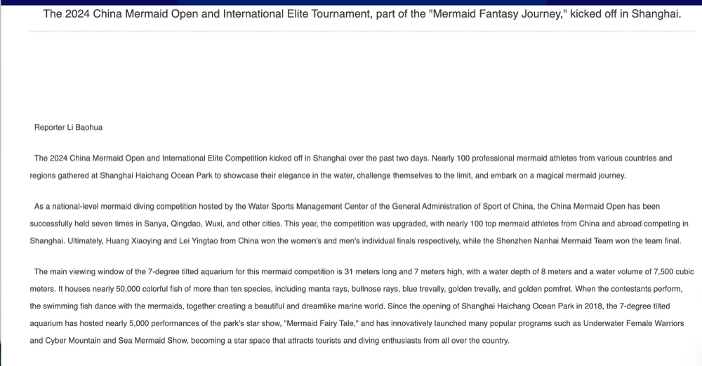
FIG.2 · SHANGHAI MUNICIPAL INFORMATION OFFICE · 2024
Strategy in use: pathos as audience engagement — the event is named and framed as a sensory experience before any athletic evaluation begins. This creates broad accessibility. The cost: it positions the audience as spectators of beauty rather than readers of athletic work.
Spectacle language is built into the event before the broadcast begins.
The 2024 Shanghai Haichang leg was officially named "Mermaid Fantasy Journey." That title is not one correspondent's word choice — it is the event's institutional identity. By the time commentary begins, the fantasy frame is already in place.
The emotional entry point is worth keeping. What changes is where it points. Open with the work's concept — not the event's atmosphere — and the audience still feels something; now they also have a question to feel it toward.
"Journey" is not a neutral word. It converts a competition into an experience meant to be felt rather than evaluated. What it displaces: the athlete's name, the scoring structure, the specific choreographic problem she is trying to solve. None of those appear in the official event title. Commentary that opens inside this frame is already working against interpretation — and the frame was set before anyone entered the water.
FIG.3 · 2022 CHINA MERMAID OPEN · NANCHANG LEG · LIVE BROADCAST
Strategy in use: narrative structure built on atmosphere — the announcer uses the work title to set a mood rather than introduce an argument. This keeps the broadcast flowing and emotionally consistent. The cost: the title's interpretive content is discarded, and the audience loses the only frame that could organize what they are about to watch.
Broadcast repeats that frame by turning title into atmosphere.
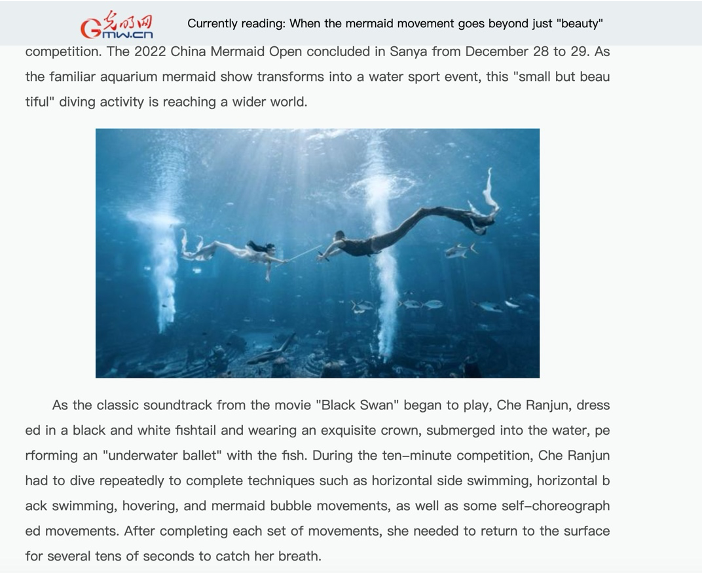
At the 2022 Nanchang broadcast, the announcer names the work title — then pivots immediately to atmospheric language. That two-second window is where interpretation either begins or collapses. Here, it collapses.
The title is the first move of the performance's narrative. Use it as such. Name the argument before the athlete enters the water, and the broadcast's emotional arc has something to follow — the work, not the image.
FIG.3 · 2022 China Mermaid Open · Nanchang Leg · Live Broadcast
At the 2022 Nanchang leg, the announcer names the work title — then immediately pivots to atmospheric language. No concept explained. No connection to the criteria. The title becomes a mood cue instead of an interpretive anchor. A work title names what the entire performance is organized around. Those two seconds are the only window to open the reading frame. Here, it closes instead.
A Xinhua-linked report on Che Ranjun's 2022 Sanya Grand Final opens: "underwater ballet with the fish." The headline had promised to go "beyond beauty." The lead sentence reinstalled beauty as the primary frame before the first paragraph ended. Sentence order is a statement of priority — and the spectacle default wins every time there isn't a system to interrupt it.
Strategy in use: ethos through familiarity — the commentator builds credibility through enthusiasm and descriptive fluency rather than analytical authority. This keeps the broadcast accessible. The cost: when the audience wants to understand a score, a gap, or a specific choice, there is no analytical framework available to answer them — and viewers notice.
The audience is not the problem. The commentary standard is.
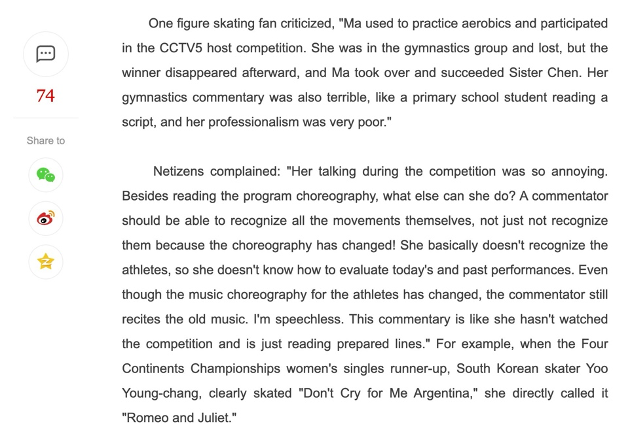
Chinese viewers of CCTV5 figure skating have already named this failure precisely: the commentator "doesn't know how to evaluate" performances. That expectation exists. Mermaid competition hasn't been held to it yet.
Ethos is built through scoring literacy — by accurately naming criteria, difficulty tiers, and structural qualities the panel is applying. Enthusiasm and analysis are not in competition. Analysis is what makes enthusiasm credible.
CCTV5 figure skating viewers named the failure precisely: the commentator "just reads prepared lines" and "doesn't know how to evaluate today's and past performances." This isn't here to compare the two sports. It's here to establish that the audience expectation already exists. Chinese viewers of athletic-artistic sport know what a serious commentary standard looks like, and they name its absence when they see it.
Mermaid competition hasn't been held to that standard yet — not because the audience isn't ready, but because the broadcast hasn't tried. A competition with four scoring dimensions, nearly fifty evaluated elements, and a dedicated art panel is not an aquarium show.
The difference is not style. It is instruction. One version teaches the audience to absorb atmosphere. The other teaches them how to read a work.
← Drag to compare →
CURRENT DEFAULT
"As the classic soundtrack from 'Black Swan' began to play, Che Ranjun, dressed in a black and white fishtail and wearing an exquisite crown, submerged into the water, performing an 'underwater ballet' with the fish."
PRESSURE LINE
"Che Ranjun has built this piece around Black Swan — a film about a performer who destroys herself to achieve perfection. Her question: can this work sustain that tension across ten minutes and six descents, without being able to hear the music she trained a thousand times to synchronize with? Watch the third surface return. That is where the structural argument either holds or breaks."
⟺
02
Section II
Our Position on the Sport
Section I showed that current coverage makes a rhetorical choice — spectacle as epideictic proof, pathos as the primary mode of engagement — even when it doesn't know it's making one. The audience is taught to feel before they are taught to judge, and that sequence is a decision. Section II argues for a different one.
Pressure Line's position is this: the scoring system already contains a complete language for reading this sport. It names what counts as athletic completion under physiological constraint, where difficulty actually sits, what expression is being asked to carry, and what kind of choreographic problem the athlete is trying to solve. These are not technical details reserved for judges. They are the terms the sport already uses to evaluate performance. Current broadcast ignores that language and substitutes its own. Pressure Line uses it as the broadcast's reading frame — and treats the audience as capable of following it. That is a choice about what broadcast authority is for: teaching the audience to read the performance, or only to feel it.
THE STANDARD ALREADY EXISTS
Pressure Line isn't inventing a better standard. It's applying one that already exists — in Olympic-level sport coverage, and in the mermaid competition community itself.
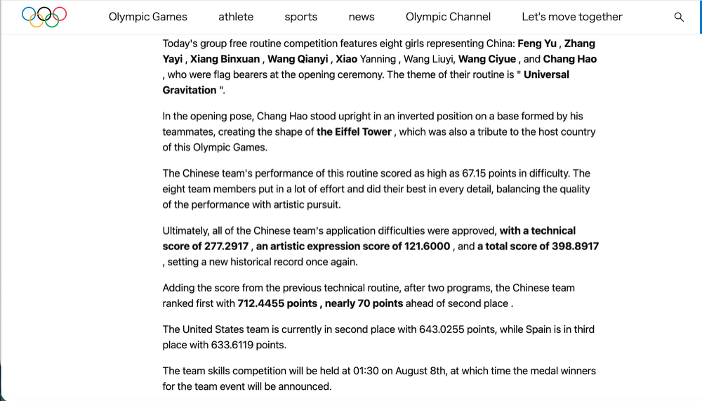
Technical score (277.29) and artistic score (121.60) reported separately. Theme named. Structure explained before the score appears. This is not special treatment for an Olympic final — it is the minimum the scoring system deserves.
↗ olympics.com · Paris 2024 · China Artistic Swimming
e.g., at 0:23 — "C-level difficulty, horizontal plane required, two props for full marks." Movement named, scoring criterion cited, difficulty tier specified. This is not expert opinion added on top of the performance. It is the scoring system spoken aloud.
Two freediving coaches analyzing Yang Lu's 2024 Asian Cup performance in real time — naming movements by technical term, citing scoring criteria, specifying difficulty tiers. This standard already exists within the sport community. Pressure Line brings it to broadcast.
↗ Douyin · v.douyin.com/h0BOWhjhr6Y/
The three cases below all center on the creative choreography dimension — the scoring category with the highest ceiling, the widest performance gap, and the most consistent absence from current coverage. They are not chosen to make the same point three times. They are chosen because they show three distinct ways broadcast authority is exercised — and misused. The first case shows a failure of omission: the score's meaning was visible but never named. The second shows a failure of reduction: a nameable choreographic problem was collapsed into a single impression. The third shows the sharpest failure — substitution: the broadcast didn't leave a gap, it filled it with a frame the athlete was refusing. Each failure is a different exercise of the same authority. Each correction is a different application of the same principle.
CASE 01 Creative Choreography · Score as structural record
Score records structure, not just excellence.
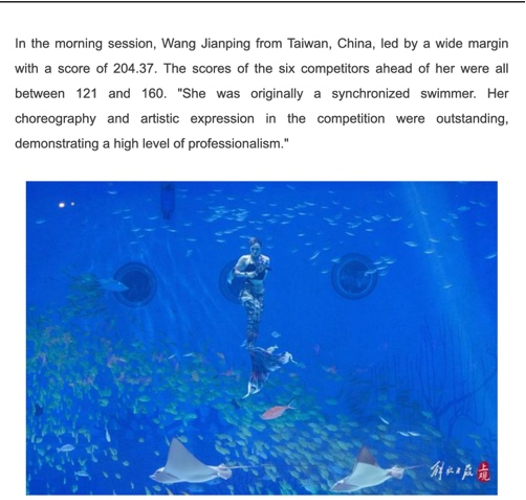
WANG JIANPING 王建萍
2024 Shanghai Haichang Leg · 204.37 pts
WHAT CURRENT COVERAGE SAID · Rhetorical failure: omission
"She was originally a synchronized swimmer. Her choreography and artistic expression were outstanding, demonstrating a high level of professionalism."
That tells the audience where the skill came from. It does not tell them what the panel actually found, or what to look for in anyone else's performance. The 45-point gap was visible in the score. The reason for it was never named. Background is a source. The scoring criterion is the explanation. Coverage gave one and omitted the other.
WHAT THE SCORING SYSTEM IS ASKING
The creative choreography dimension rewards internal logic, not polish. Do movements set something up and resolve it? Does the routine build phrases, or only display elements? The 45-point gap between Wang Jianping and the field is not a generic sign of superiority. It is the panel's record of a structural quality the rest of the field was not building at the same level. Current coverage named her background. The dimension that produced the gap was never named.
"Wang Jianping scored 204.37. The gap to second place is 45 points. That number is not a sign of how polished she looked — it is the panel's record of a structural quality the rest of the field was not building at the same level. The criterion is creative choreography: do movements set something up and resolve it? Does the routine build phrases, or just display elements one after another? Watch how each descent finishes what it started. Nothing just hangs in the water unresolved. Every sequence prepares the next. When the score appears, you will know what 45 points actually means — not superiority in general, but one specific thing the panel could name and the field could not match."
FOR BROADCASTERS
When a score gap appears, identify the dimension that produced it and explain the structural quality it measured. Background tells you where the skill came from. The criterion tells you what the panel found.
CASE 02 Performance Expression · Choreography as translation problem
Choreography is a translation problem the audience can watch for.
GUO KE 郭克
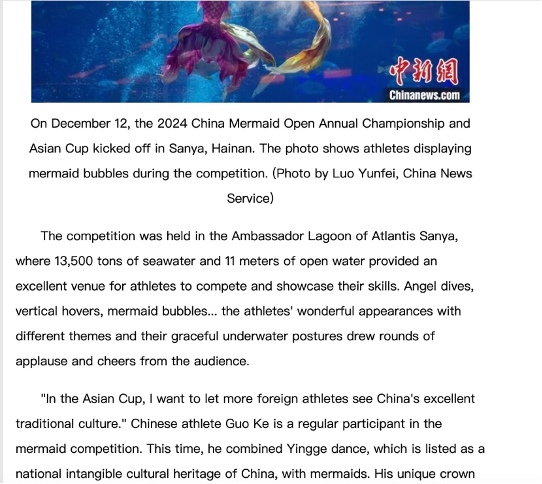
2024 Asian Cup Grand Final · 《英歌舞》Yingge Dance
WHAT CURRENT COVERAGE SAID · Rhetorical failure: reduction
"Distinctive." A placement recorded. The tradition named. The argument never explained.
"Distinctive" is an impression. It takes a specific, nameable choreographic problem — a warrior tradition being translated into an underwater solo — and reduces it to a single adjective. The audience is not given a gap to see (there is no 45-point number here). They are given a word that closes off the question rather than opening it. A reduction is not the same as an omission: coverage did address the performance, and did name the tradition. It just refused to say what the problem was.
WHAT THE SCORING SYSTEM IS ASKING
The Yingge dance runs on three physical qualities: weight (gravity-driven, downward), percussion (rhythm that comes from impact), and collective force (a warrior tradition built for groups). All three are in direct tension with what an underwater solo routine can physically do — a monofin moves horizontally, buoyancy resists gravity, breath-hold removes percussive exertion, and solo format removes the collective. The creative choreography panel was asking one question: did the translation hold? Coverage reported a placement and one adjective. No score breakdown appeared. The audience received an impression where a reading frame should have been. The absence of a score breakdown is itself the evidence — what the panel measured was never made available.
"Guo Ke has built this routine around the Yingge warrior dance — a tradition that runs on weight, percussion, and downward force. All three of those qualities are in direct tension with what underwater movement can physically do. Watch whether the movement keeps pulling down or drifts up. Watch whether it feels struck or merely swayed. Watch whether there is a sense of mass and collective weight even inside a solo performance. Those three questions are exactly what the creative choreography panel is answering. You do not need to wait for the score to ask them. But when the score appears, you will know what it measured — and whether the translation held."
FOR BROADCASTERS
Name the tradition, define the tension it creates, and give the audience two or three physical signs to watch for. That is the difference between an impression and a reading frame.
Guo Ke's case showed that broadcast owes the audience a problem to watch for, not just a result to receive. Hong Xuhua's case shows why this matters even more acutely: because when broadcast does not hold the athlete's frame in place, it does not simply leave a gap. It fills the gap with its own frame. Omission was the failure in Case 01. Reduction was the failure in Case 02. Case 03 is the hardest version: the broadcast was not silent. It spoke — and in speaking, it replaced the athlete's argument with one she never made.
CASE 03 Creative Choreography · Title as interpretive claim
The title is the athlete's argument. Broadcast must hold it in place.
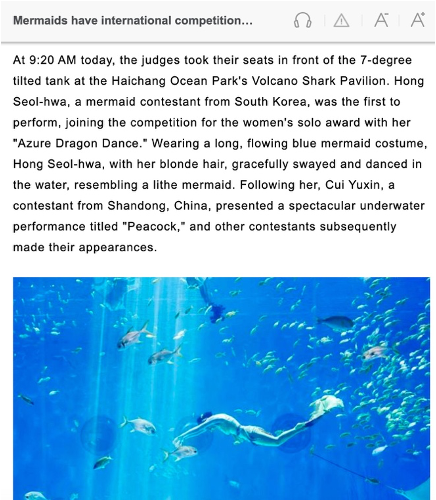
HONG XUHUA 洪雪华
2024 Shanghai Haichang · 《青龙舞》Azure Dragon Dance
WHAT CURRENT COVERAGE SAID · Rhetorical failure: substitution
"Wearing a long, flowing blue mermaid costume, Hong Seol-hwa, with her blonde hair, gracefully swayed and danced in the water, resembling a lithe mermaid."
The title is "Azure Dragon Dance." The coverage described her as a mermaid — the exact image the title was refusing. This is not omission and it is not reduction. Coverage did not leave a gap or collapse a question. It actively placed a different interpretive frame over the athlete's own. The broadcast didn't miss the work. It rewrote it. The athlete made a rhetorical argument with her title. The broadcast made a different one and published it under her name.
WHAT THE SCORING SYSTEM IS ASKING
In Chinese cultural symbolism, the dragon is the opposite of the mermaid — power over grace, force over flow. Naming a routine after a dragon inside a mermaid competition is making an argument with the title: this performance will push against the competition's default aesthetic. The art panel evaluates whether the choreography and expression deliver on that argument. The broadcast received the title, noted her hair color, and returned the audience to the mermaid frame. The title's claim was never held in place long enough to be tested.
"The title is 'Azure Dragon Dance.' In Chinese symbolism, the dragon is not a gentle creature — it is directed force, power with intention, will made physical. The mermaid is its opposite: passive grace, flow, beauty without weight. Naming this routine after a dragon, inside a competition built around mermaids, is making a specific argument with the title itself: this performance will push against the aesthetic the competition defaults to. Watch whether the movement carries force or grace. Watch whether it strikes or floats. Watch whether it demands something from the space, or simply passes through it. Keep those questions in front of the audience from the first descent. When the score appears, it will tell you whether the argument held."
FOR BROADCASTERS
The title is not a label. It is the first claim the performance has to deliver on. Keep that claim in front of the audience long enough for them to judge whether the performance answers it.
Three cases, three forms of the same failure. Omission: the score's meaning was there, never given. Reduction: the choreographic argument was nameable, never named. Substitution: the athlete's interpretive frame was received and replaced. Each one is a different exercise of broadcast's rhetorical authority — the authority to define what the audience sees, what they are taught to ask for, what counts as an explanation. Pressure Line's position is not that current coverage is dishonest. It is that broadcast authority is unavoidable, and the only question is what it is used for. Used for spectacle, it teaches the audience to feel. Used for the sport's own evaluative language, it teaches them to read. Section III turns that second use into a set of standards.
"A score named without explanation is a fact. A score explained is an argument."
03
Section III
Broadcast Standards
These are not suggestions. They are Pressure Line's broadcast defaults — built from the evaluative framework the previous two sections established. Section I showed what current coverage costs the audience. Section II showed what the scoring system already makes available. The standards below define how Pressure Line uses that language across commentary, camera, and editing.
A performance that lasts ten minutes and involves six descents has a structural arc. Commentary's job is to make that arc legible: establish the work's argument before the first descent, track how each sequence advances or complicates it, and resolve the narrative when the score explains what the construction achieved. Every camera frame and editing cut either supports that arc or breaks it.
01
Commentary
Rhetorical function: narrative structure. Every call establishes, advances, or resolves the performance's argument. The score is the conclusion — not the event.
1
Before every descent: name the work, state the concept, identify what the panel is evaluating.
The audience cannot follow a structural argument they were never given. A title named without a concept is a label, not an opening. This is the only moment to establish the reading frame — once the athlete descends, it is too late. Everything the audience watches will be received as image rather than argument.
2
Name every significant movement by its technical term, then explain what the athlete is managing at the same time.
"Tail-up rotation" names the movement. "Ankle above the head at mid-descent, breath reserve at its lowest" explains the cost of executing it. Without the second sentence, difficulty is invisible — the audience sees a clean line rather than an achievement earned under physiological constraint. Naming alone is not enough. The constraint is the argument.
3
When the score appears, name the dimension and explain the structural quality it measured.
A score named without its dimension is a verdict without a reason. The audience cannot learn to read future performances from a number alone. Name the criterion — creative choreography, technical difficulty — then explain the specific quality that separated this result from others. That explanation is what turns a score into an argument.
4
Use silence when the performance should lead.
Not every moment needs language. When expression is doing compositional work — when the athlete is delivering the performance's concept — narrating over it competes with it. The rule is not silence for its own sake. It is silence in service of what the athlete built, so that interpretation, when it comes, has something earned to point to.
5
Before every surface return, tell the audience what comes next and how it connects to what has already been built.
The surface return is the only moment when the athlete is stationary, the audience is waiting, and commentary can speak without competing with movement. Use it: name what was just built, name what comes next, and connect both to the performance's central argument. A narrative arc only works if the audience can track where they are in it.
02
Camera
Rhetorical function: ethos. Framing decisions either demonstrate analytical authority — showing what the scoring system evaluates — or default to spectacle.
1
One wide establishing shot at the start. After that, leave it unless the spatial condition becomes newly relevant.
Depth is a performance condition — it determines breath-hold duration and affects scoring difficulty. The wide shot establishes that once. Every return to it after that is a choice to show the environment rather than the athlete. It is a spectacle decision, not an analytical one.
2
Medium frame — crown to monofin, water visible — is the primary frame during descent sequences. If you cannot justify leaving it in compositional terms, stay in it.
This is the only frame in which movement completion, body line, and spatial intention are simultaneously readable — the three things the scoring panel is evaluating. Tighter loses structural context. Wider loses the legibility of individual choices. Deviation requires a compositional reason, not a visual one.
3
Marine life is environment, not content. Cut to it only if it directly clarifies something about the performance condition.
Marine life cutaways are a spectacle reflex — they fill visual space with something aesthetically legible rather than holding on what the athlete is doing. The justification threshold is high: only cut if the animal directly affects performance conditions and the panel would note it. Otherwise, you are telling the audience the interesting thing is the environment.
4
Close-ups show what the athlete is choosing to make visible — not what catches the light.
Not every expressive moment earns a close-up. The question is whether the face is delivering the performance's concept — whether the art panel would score what you are showing. A close-up motivated by visual beauty rather than expressive intention is a pathos decision. It aestheticizes the work instead of reading it.
03
Editing
Rhetorical function: controlling pathos. Atmospheric cuts redirect emotional attention away from the work. Every cut either serves the argument or interrupts it.
1
Cut at structural breaks — not visual opportunities. If a cut is motivated by visual excitement rather than structural transition, it is almost certainly the wrong cut.
The valid moments to cut are: between descent groups, during surface recovery, at transitions in movement logic or musical phrasing. A cut motivated by what looks striking mid-sequence does not add emphasis — it severs the argument the athlete has been building. The audience loses the thread.
2
In team events, hold the full-width frame through synchronized sequences.
In team events, synchronization is a scored criterion. Cutting to one athlete's face during a synchronized sequence is not dramatic — it is a failure to show what the panel is evaluating. The argument exists in the full frame: the spatial relationship between athletes, the precision of simultaneous execution. A single face cannot carry that argument.
3
No atmospheric inserts during active performance.
Any insert during a descent — tank wide-shot, fish cutaway, crowd reaction — tells the audience the interesting thing is outside the athlete. The performance cannot make its structural argument if the camera is elsewhere. Atmospheric inserts are the editing equivalent of spectacle commentary: they fill time with affect instead of holding on what is being built.
Six descents, no music, structural tension sustained
HONG XUHUA 洪雪华
《青龙舞》— Azure Dragon Dance
2024 Shanghai Haichang
Title refuses the competition's central image
WANG JIANPING 王建萍
Phrase structure at competitive density · 204.37 pts
2024 Shanghai Haichang
Phrase structure — judges put 45 points between her and the field
Guo Ke asked whether a warrior tradition built on ground percussion and downward force could survive translation into breath-hold propulsion through water. Che Ranjun asked whether a piece built around the cost of perfection could hold tension across repeated descents without hearing the music. Hong Xuhua named her routine after a dragon and asked whether the performance could deliver on that claim. Wang Jianping brought phrase structure into a scoring context that had rarely seen it at that level.
What links these performances is not beauty, but authorship: each athlete set a problem, built a structure, and submitted that structure to judgment. Current coverage called the results beautiful. That is not false. It is simply a description of something else — what the performance looks like from the outside. Pressure Line broadcasts what the performance is doing on the inside.
All three pressures — depth, breath-hold, and interpretive — are present in every performance. Current broadcast names the first. Pressure Line names all three.
The scoring system already knows how to read this sport. The broadcast hasn't been using it. Pressure Line does.